Custom tennis bags are one of those products where the order looks simple and the disappointment shows up later. The bag arrives, and the club discovers it holds fewer racquets than the name promised, the logo is fuzzy where the design had small text, or the zipper that failed first was the one nobody thought to ask about. None of these are bad luck; they are predictable mistakes made at the ordering stage. Here are the ones worth designing out before you place a bulk order for a team, a club, or a retail line.
Buying by the racquet number on the label
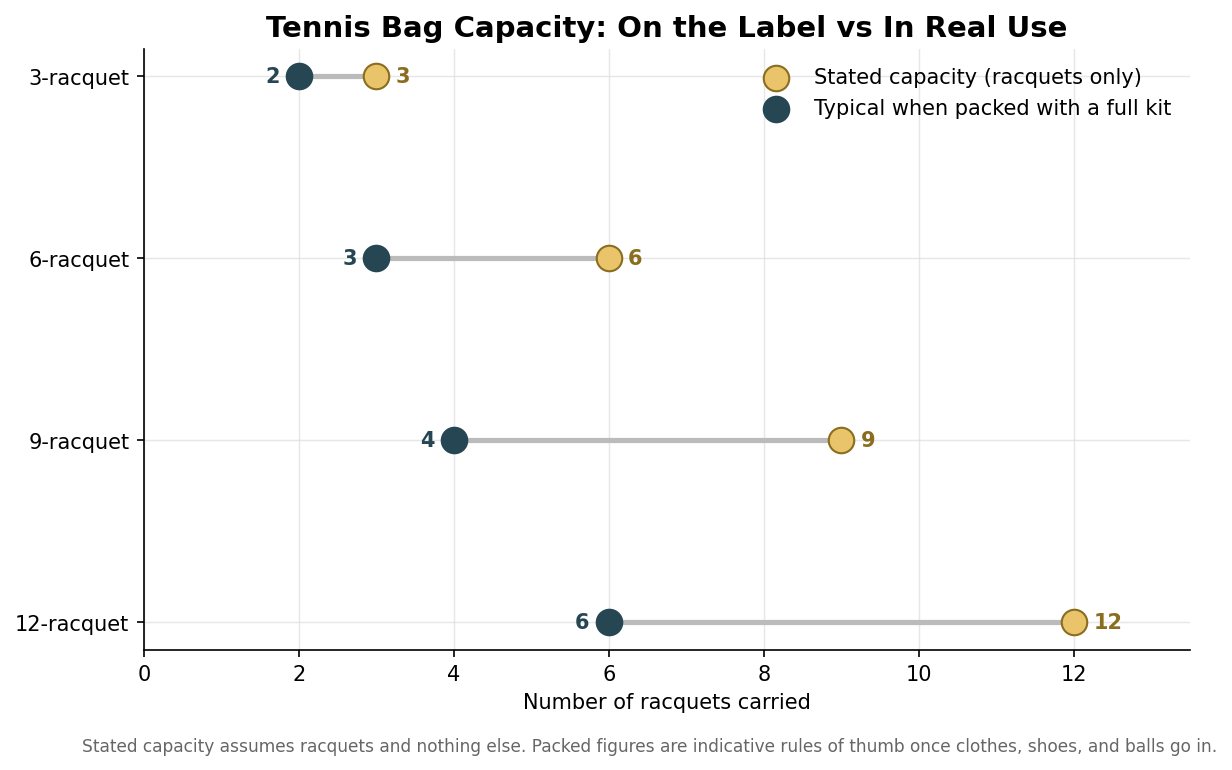
The number in a bag’s name, three, six, nine, or twelve, is a theoretical maximum that assumes the bag is stuffed with racquets and nothing else. Real players carry a kit. Once a change of clothes, shoes, a few balls, grips, and a water bottle go in, a six-racquet bag realistically carries two or three racquets plus that gear, and a twelve is closer to a tournament or coaching load than an everyday one. Size up from how the bag is actually used, not from the headline count. For a junior squad that hauls one racquet and a full change of clothes, the compartment layout and the shoe pocket matter more than the racquet ceiling. For a stringer or coach, the higher counts earn their bulk. Ordering a size or half a size larger than the label math suggests is the cheapest insurance against a bag that will not close.
Paying extra for a thermal compartment that does not insulate
Many bags advertise a climate-protected or thermal-lined compartment, and it is easy to assume it keeps racquets and strings safe in a hot car. Independent testing tells a less flattering story. The linings most bags use are a thin open-cell foam with a foil layer, and in side-by-side tests against unlined bags the temperature difference effectively disappears within an hour, with the lined compartment sometimes running slightly warmer. Real thermal protection needs thick closed-cell foam of the kind soft coolers use, not the thin material a tennis bag can spare. This does not make the feature worthless as padding, but do not pay a premium for it as insulation or promise it to customers as such. The genuinely effective moves are behavioral: keep the bag in shade, leave the zippers cracked to vent trapped heat, and never leave racquets in a hot trunk or a freezing garage. If your buyers care about their strings, that guidance serves them better than a foil pocket.
Picking the decoration method before you look at the logo
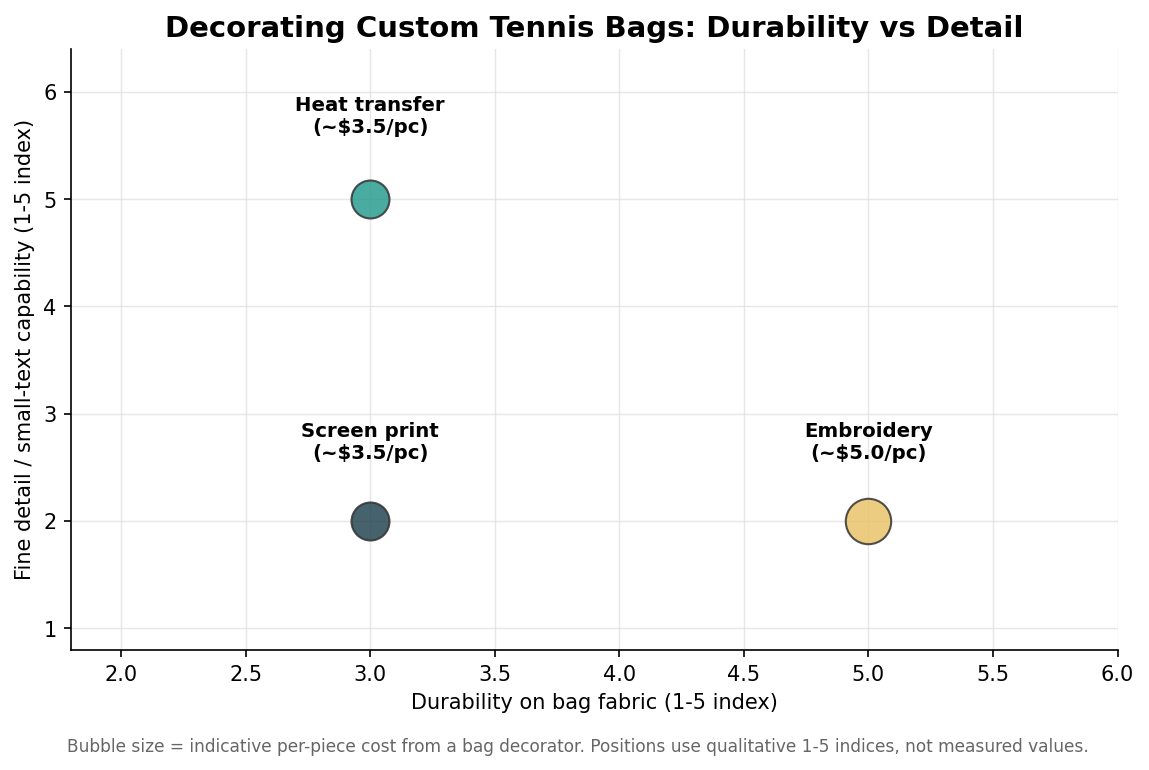
The right way to decorate a bag depends entirely on the artwork, and choosing the method first is how logos end up muddy. Embroidery is the most durable and looks premium, but it reproduces only low-to-moderate detail, so fine text, thin lines, and gradients get lost in the stitching. Heat transfer handles full color, gradients, and small detail best, which makes it the choice for a complex or photographic mark, at moderate durability. Screen printing gives vibrant, limited-color results economically at volume but is not built for intricate art. Indicative per-piece decoration costs from bag decorators fall roughly in the two-to-five-dollar range for screen printing and heat transfer and three-to-seven for embroidery, and most decorators set a minimum around one hundred pieces per style. Match the method to the logo: a simple two-color club crest embroiders beautifully, while a detailed sponsor lockup with small type belongs on heat transfer. Deciding this before you commit the artwork saves a reorder.
Skipping the pre-production sample on a team order
The single most expensive mistake is approving artwork on a screen and going straight to a bulk run. On a team order, small inconsistencies multiply: a logo placed a little high on one batch, a thread color that reads slightly off against the bag fabric, an embroidered mark that puckers on a thin panel. A pre-production sample, or at least a digital proof with exact placement and dimensions, catches these while they are still free to fix. Confirm the decoration position with real measurements rather than a vague description, lock the thread or ink colors to a standard so reorders match, and check how the mark sits on the actual bag material, since embroidery behaves differently on a padded racquet compartment than on a thin accessory pocket. Fifteen minutes of proofing prevents an entire delivery of near-misses that a club has to live with all season.
Underbuilding the parts that fail first
Bags rarely fail in the middle of a panel; they fail at the zippers, the strap anchors, and the base. A loaded tennis bag is heavy, and it gets dragged, dropped, and slung onto hard courts daily. When you compare quotes, look past the fabric denier to the hardware: the zipper gauge and whether the pulls are reinforced, whether the shoulder-strap attachment points are bar-tacked, and whether the base has any reinforcement or feet to survive being set down on rough surfaces. A ventilated shoe or wet-kit pocket is worth confirming too, because damp shoes sealed against clean clothes is a complaint you will hear about. Spending the marginal cost on better zippers and stitched-down straps is almost always cheaper than fielding warranty returns from a team that used the bags exactly as intended. Order the bag for the abuse it will actually take, and the rest of the specification has room to be about looking good.