Tennis bags are sold by a “pack” number, and the number is optimistic. A 12-pack does not mean you will carry twelve racquets any more than a 6-pack means six; the rating counts racquets and nothing else, so the moment shoes, a change of clothes, and a few cans of balls go in, the usable racquet count drops. Reading the formats for what they actually hold, and how they are built, makes the choice between them straightforward.
What the pack ratings really mean
The pack number describes racquet capacity with the bag otherwise empty. A 3-pack is a single-compartment bag that realistically carries one or two racquets plus balls, a water bottle, and a towel, which is exactly what a casual or weekend player needs. A 6-pack (often sold as 6-to-9) steps up to two compartments and enough room for several racquets alongside spare clothing, strings, and grips, the sensible choice for someone playing a few times a week. A 12-pack (sold as 12-to-15) is the tournament format: three compartments, space for backup frames, shoes, and a full kit, and the size most likely to feel cumbersome once it is loaded. The step between ratings is real, but treat each number as a ceiling for racquets, not a promise of racquets-plus-gear.
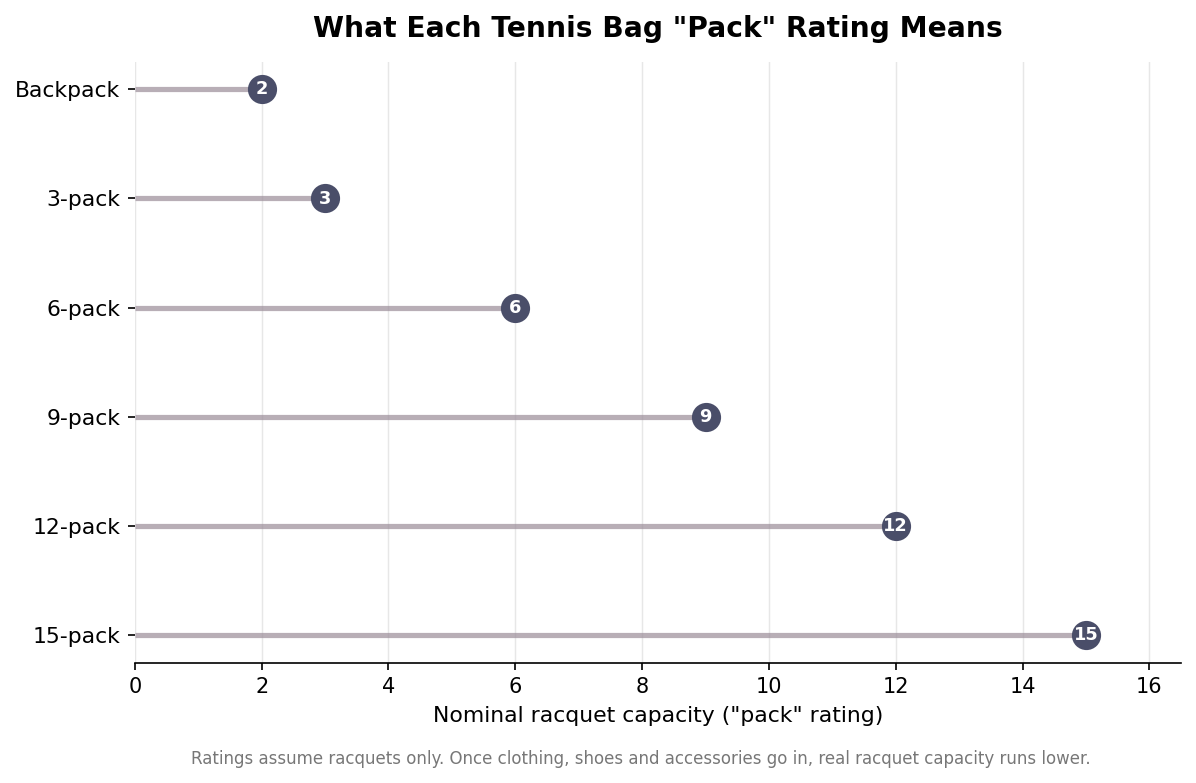
The practical takeaway is to buy for your gear, not your racquets. A club player who owns two frames but hauls shoes, a warmup layer, and a lunch will be better served by a 6-pack used half for racquets and half for everything else than by a 3-pack that technically fits the frames but nothing around them.
Compartments are the feature that scales
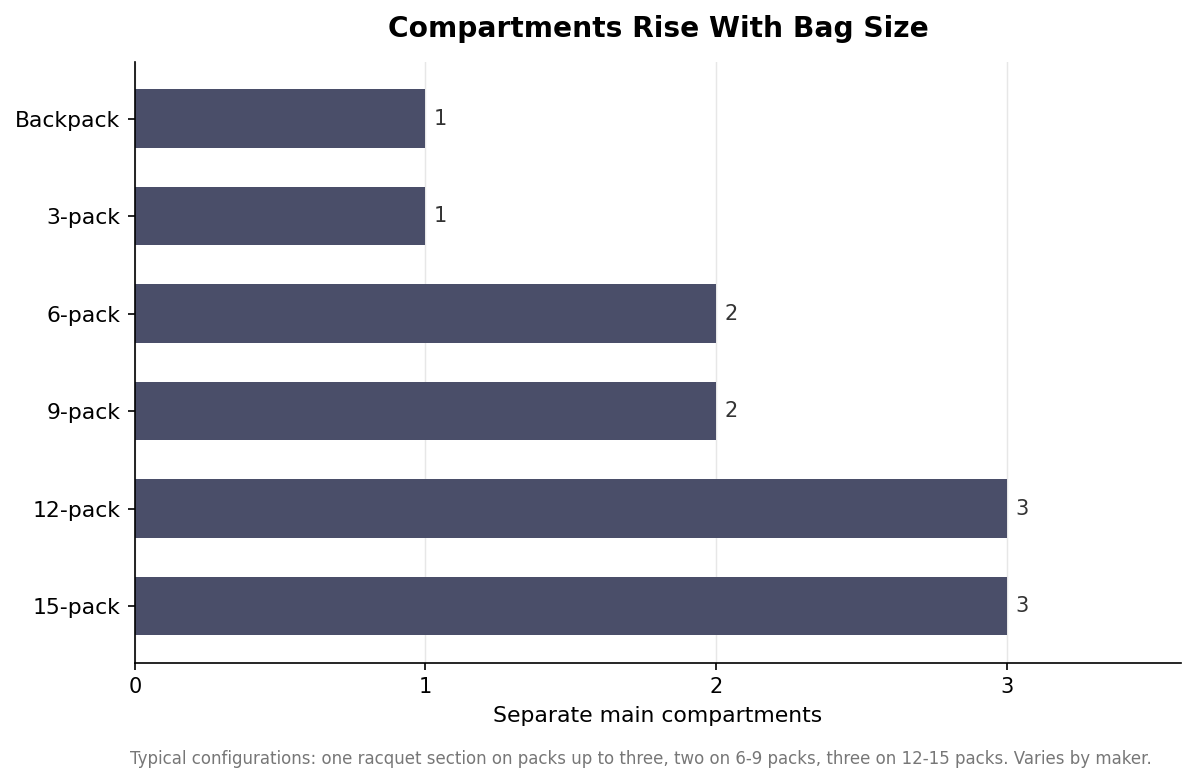
What changes most as you move up the range is not raw volume but how the space is divided. Smaller bags give you one main compartment, so racquets, damp towels, and clean clothes share a space. Mid-size bags add a second compartment, which lets you keep sweaty gear away from dry kit. The largest bags carry three, typically two racquet-holding compartments and a separate section, so a tournament player can isolate shoes, wet clothes, and frames from one another. If staying organized on a long day matters more to you than sheer capacity, count compartments before you count the pack rating.
Thermal lining and the pockets that matter
Larger bags advertise a thermal or “Thermoguard”-style lining on at least one compartment, and it is not marketing filler. Racquet strings lose tension over time, and heat accelerates it; a graphite frame and its string bed left in a hot car trunk or in direct sun on a summer court sit in temperatures well above ambient. The thermal lining is an insulating barrier that slows how fast that heat reaches the frames, buying you more stable string tension between restrings. It does not refrigerate anything, so it helps most when the bag will genuinely sit in heat. A player who goes straight from an air-conditioned car to an indoor court gains little from it, while anyone leaving a bag in a vehicle through a hot afternoon gains real protection. Weigh it accordingly rather than paying up for a feature your routine never triggers.
The smaller pockets often decide day-to-day usability more than the headline capacity. From the 6-pack up, most bags add a ventilated shoe compartment, a separate zippered tunnel with mesh panels that lets a damp pair breathe instead of steaming your racquets and clothes. Around it you will usually find a moisture-resistant valuables pocket sized for a phone and keys, a soft-lined pocket for sunglasses, and exterior mesh sleeves for a bottle. When you are comparing two bags of the same pack rating, these are the tiebreaker: one with a true vented shoe tunnel and a dedicated valuables pocket is meaningfully more usable than a plain bag holding the same number of racquets.
Backpacks, duffels, and totes
Not every bag follows the pack system. A backpack carries one or two racquets in a padded sleeve and leans on accessory pockets, mesh side pockets, and a ventilated shoe tunnel, which makes it the most useful format for a player who also commutes or trains off court. A duffel keeps a single large compartment with a zippered section that lets racquet heads sit inside or protrude, trading organization for a clean, understated look. A tote is the style-led option, with intentional racquet and shoe pockets built into a more fashion-forward shape, popular for social play where the bag doubles as an everyday carry. None of these are wrong; they simply optimize for portability and looks rather than maximum capacity.
Durability lives in details the pack rating ignores, too. Most quality bags use a heavy denier polyester, often in the 600 to 1200 denier range, sometimes with a water-resistant coating on the base panel that meets the ground, and the zippers do much of the work. Large-tooth, smooth-running zippers on the racquet compartments are worth checking, since a blown zipper on a loaded tournament bag ends the bag’s useful life well before the fabric wears out.
Choosing the format, and the branding surface
Work from your heaviest normal day. If that day is two racquets and a water bottle, a 3-pack or a backpack is honest and light. If it is several sessions a week with a change of clothes, a 6-pack with two compartments covers you without becoming a burden. If it is tournaments, travel, and backup frames in variable weather, the 12-pack’s three compartments and thermal lining are worth the bulk. For a club, team, or brand ordering in quantity, the format also decides your decoration surface: the broad flat end panels and main flap of 6- and 12-packs give embroidery or print a large, stable area, while backpacks and totes offer smaller front panels better suited to a compact logo. Pick the format for how the bag will be used first, then let its largest clean panel carry the branding.